
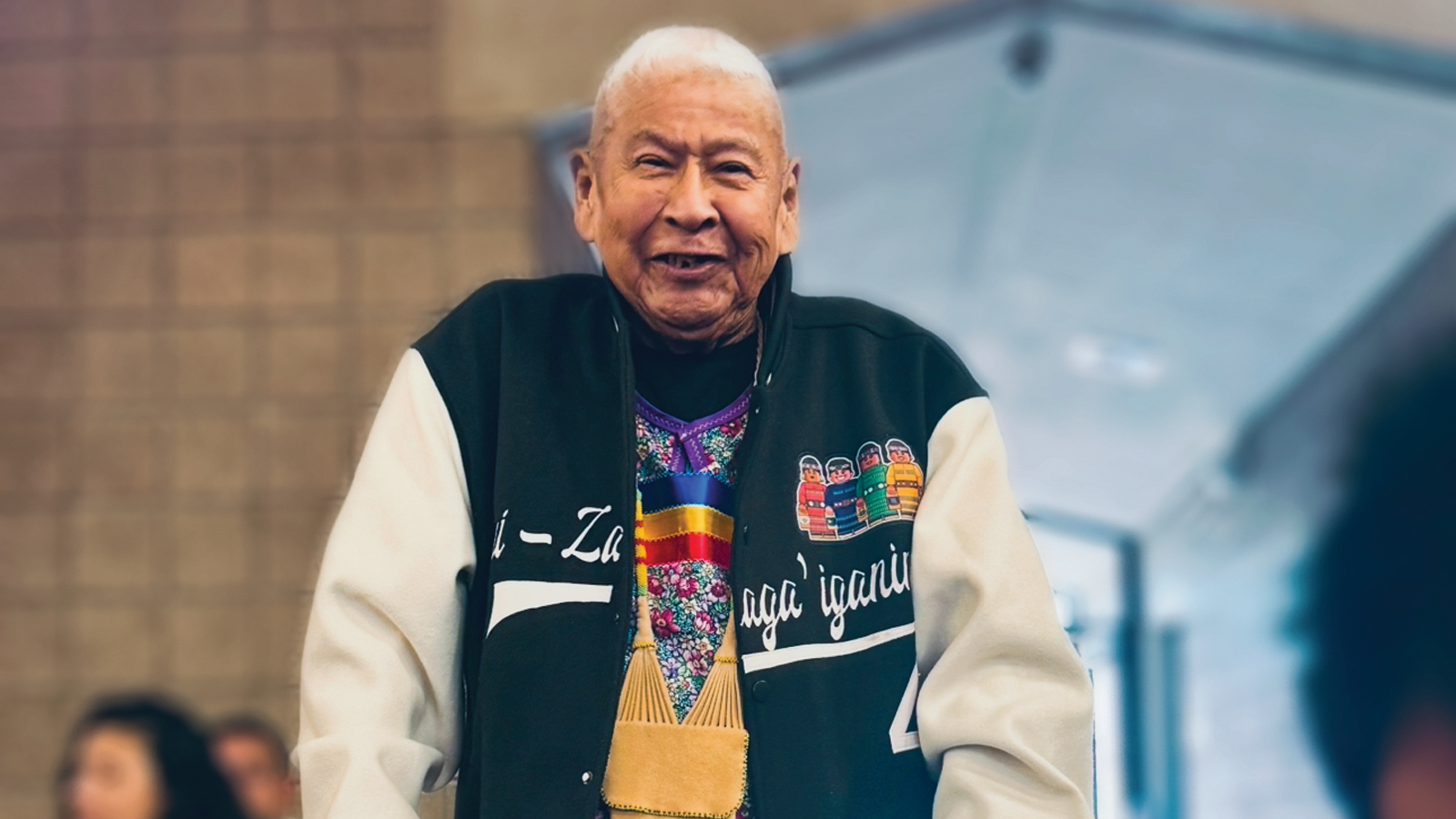
This is the first of a series of articles honoring the trailblazers — parents, elders, and leaders — who fought for sovereignty, preserved cultural traditions, and laid the foundation for today’s tribal enterprises. Sons and daughters will share stories of their parents’ contributions, reminding us that the leadership we carry forward is rooted in the strength and vision of those who came before us.
Chemical Dependency Counselor, Ojibwe Language Teacher, and Drum Keeper
Joe Nayquonabe’s son, Joe Nayquonabe, who is CEO of Soaring Eagle, Mt. Pleasant, Michigan, remembers his late father for the various eras of his life: as a decorated Vietnam veteran, a chemical dependency counselor, an Ojibwe language teacher and tribal drum keeper, all packed into his father’s huge frame.
But the main thing Joe relates about his father through all the eras of his life was his amazing spirit.
“He was just a humble guy,” Nayquonabe said. “When I send you a picture, the smile that he had; that’s basically how he always was. He was always smiling. He was always trying to find the positive. His Indian humor was incredible, and people just wanted to gravitate towards that energy. And he never, never ran out of it. That was one of the cool parts about him. He never got tired of meeting people and trying to impact people. It’s pretty cool. That’s just who he was,”
Joe’s father, who passed away on May 21, 2025, decided to stop drinking and smoking one day after decades of leading a hard life of dependency after leaving the army. He was treating his PTSD using alcohol. That led to over two decades as the legendary chemical dependency counselor for the Mille Lacs Band of Ojibwe.
Purple Heart and Bronze Star
Joe’s father was born in 1944 on the Mille Lacs Reservation as one of nine children in a two-bedroom house. Joe’s grandfather passed away in the early 1950s. The house had no running water and no electricity until the mid-1950s, and families used an outside central pump for fresh water.
Nayquonabe started working when he was about 13 years old, mowing yards, raking, putting docks in, and painting boats for local resorts.
He joined the army when he was 22 years old. He served with the First Infantry Brigade (Big Red 1) in Vietnam in 1966 and 1967 and was wounded in a firefight on Dec. 4, 1966.
He received shrapnel in his back and was awarded a Purple Heart and Bronze Star for valor for continuing to fight after he was wounded.
Joe was diagnosed with PTSD after his discharge.
“We would go back there to the house my dad grew up in, and it was really cool because my grandma was kind of the neighborhood mom,” Nayquonabe said. “Everybody would gather there, and she would always have some sort of soup on. People would be hanging out, and my dad would tell us that’s basically how it had always been. So, there had always been a pretty vibrant activity there.”
I asked Nayquonabe if his father ever talked about his Vietnam experiences. “He was a really proud vet,” Nayquonabe said.
His father attempted to enlist but was rejected for flat feet. Later, he was drafted.
“He was there for almost like six months exactly, from July all the way until December,” Nayquonabe stated. “He ended up carrying a guy off the battlefield. He would never talk about how he got injured or what the circumstances of him getting hurt were. He talked glowingly about going from Vietnam and waking up in Hawaii, and he talked about the big pink hospital in Honolulu where he was sent. Vietnam was one of his most prideful things because it meant so much to him.”
Unknown Man
Things changed when there was an unexpected knock on the door, and his father had a discussion with an unknown man outside. It was the man his father rescued in the jungle in Vietnam.
“That’s how he started to open up about that,” Nayquonabe related. “He would have bad recurring dreams. In his dream, the guy was mad that he had saved him because he had a handicap afterwards. So, that was one of the reasons he never really shared it because that was one of his recurring dreams. He would wake up in that hospital, and that guy would be there, kind of yelling at him; and later on, he told us those recurring dreams, and then that’s when he told us the full backstory about what had happened.
“The guy was really grateful. He found my dad after all those years and came up to the house and then stayed in contact with him. So yeah, it ended up being a cool story.”
Drums
Joe tells the story that his father believed he was protected before and after Vietnam because of the drum ceremonies he received.
“Coming home, a lot of his buddies that weren’t from the rez were met with protests and things like that when they got home,” Nayquonabe stated. “But when he got home, because he was harmed in battle and because he had seen blood, there are roles for that in our big drum society. There are four songs that are specifically for those veterans. He always felt like the drums and those people that danced for him, and the songs sung for him before he went, are what kept him safe.
“He believed it was those drums and the people that were part of those drums that took care of him when he got home. So, he really credits the drums with how he dealt with and survived Vietnam, both before, during, and after the war. And so, he was always pretty open with that, and pretty prideful.”
Sculpture
“He did a lot of work for the Minnesota veterans’ community, and they gave him an honorary award five or six years ago,” Nayquonbae said. “They just told us that they’re building this new museum, and they commissioned a sculpture of him for the Vietnam exhibit because of their interaction with him and what he did for Indian veterans in the state. He would laugh about that because he was just a humble guy.”
Joe’s father went through a decade after leaving the military where he was drinking and smoking three packs of cigarettes a day. In published reports, he said the reason he decided to stop drinking was that his own father died young, and he did not want his children to be without a father.
“I was born in 1982, and so I don’t remember him ever smoking or drinking, but my older brother and sister remember it kind of loosely,” Nayquonabe said. “He didn’t really talk about it that much until later in life, when he talked about that decade where he just couldn’t sleep. He would have to drink to sleep. That was a lot of what he was dealing with.
“He just told us before he passed, and I had never heard it before, but early in his sobriety, he was trying to get his brothers and his friends to stop drinking with him. They would kind of lash out at him, like, ‘Oh, you think you’re better than us now just because you don’t drink,’ and it almost got physical.”
“The first priority for him was to spend time with us. He would come home and we’d go for runs, we’d go golfing, we’d go bowling, we’d go lifting weights, play racquetball. He was just constantly trying to keep us busy and keep us out of trouble. He said, the key to this is that he went through this experience in Vietnam, and then he came back with PTSD, and he became a Chemical Dependency Counselor. And so, he became a counselor based on all of that. And the reason he quit was basically because of the kids,” Nayquonabe said.
Red Brick House
Joe’s father spent 22 years as a chemical dependency counselor and was influential in helping secure a red brick building that was used for outpatient services.
“He fought really hard to have this halfway house acquired on the reservation,” Nayquonabe said. “When people were cleaning up, they could come back to the rez and do outpatient at the halfway house. That was just a big deal. He would bring us to watch him administer a group. I can see myself in that place as a little kid, at the halfway house at Mille Lacs. It’s a red brick building, right off the reservation.
“That became the gathering place for AA meetings and therapy and things like that. Everybody just knows it as the ‘red brick house,’ that’s where his office was. For 20 years, everybody would associate that building with him. I remember being there observing quite a bit. I just think about those places because they’re like, synonymous with him and synonymous with the start of the sobriety movement on the rez. He was the staple, the figurehead. Even today, I think people would probably point to him as the guy they think about when it comes to sobriety,” Nayquonabe said.
Joe’s father would tell his children stories about the people he worked with as a counselor and use those stories as learning moments.
Biggest Life Lesson
“He hung out with so many alcoholics in his life that he had all these stories, his own stories and their stories,” Nayquonabe said. “He would tell us some of the craziest things, and it would always be this sort of light, humorous thing, but it would wrap up with some sort of knowledge that he wanted us to take with us.
“Dad graduated from college, from Saint Cloud State University, when he was 48 years old. He’d take us around campus. He was really influential in building up the Indian Resource Center there on campus.
“The value of education was probably the biggest life lesson that he passed on to us. He preached it all the time, and he wanted to demonstrate it to us. You know, learn something that you can bring back to the tribe and help contribute to the tribe. So, we all grew up that way. It was like there wasn’t any other option. That’s what we felt like we were expected to do,” Nayquonabe recalled.
Life’s Eras
“He had these eras of his life: the Vietnam era, and then the sobriety era, and then, most recently, he was known for his language and culture preservation,” Nayquonabe said. “He’d been trying to pass on the Ojibwe language because he was one of the only first speakers left in the tribe. He was very fluent and a good teacher, and could teach people how to speak Ojibwe. And then he was also a drum keeper in the community, so he had all of this knowledge about drums. And he would go to all of the different drum ceremonies around Minnesota and Wisconsin. If we asked people that have met him since he retired, so, like, the last decade, they would all associate him with language and drum preservation and passing on those teachings.”
Language and Oral Tradition
“There were several members of the community that wanted to learn the language, wanted to invest time, and they would literally seek him out,” said Nayquonabe. “They’d travel with him to the drum ceremonies, and the entire car ride was just lessons in Ojibwe. They would sit there and talk. I would sit and listen in the back.
“It’s also pretty cool that he allowed himself to be recorded quite a bit, which, years ago, you just didn’t see a lot of. He was watching his friends pass in their sixties, and they had all this knowledge, and then it was just gone. And he worried about that. He threw the conventions out that everything to that point was really passed on through oral teaching. I think he said, ‘Look, I’d rather have you guys capturing this stuff and keeping it than it disappearing.’ So that was a little controversial in the beginning, but it became a thing.
“Why was it controversial?” Nayquonabe continued. “Mainly because there’s a lot of beliefs that those teachings are supposed to be only passed on through oral tradition. If you want it bad enough and if it’s important enough to you, you should take the time to learn it through that oral passing. But it’s just a different world today, you know, digital learning,”
Drum Keeper
“There is a lot to drums,” said Nayquonabe. “There are the songs, the order that the songs should be sung, and the prayers that are associated with the songs. Again, it was kind of taboo to be sharing a lot of that stuff, but he didn’t even care because he wanted it to carry on. The last twenty years of the drums in our community ebbs and flows like other kinds of beliefs or religions.
“In this era, he was really responsible for seeing a huge comeback of people showing up to those drums, to the point where we’re building out our ceremonial halls where we hold these things. They are actually doubling and tripling the size of these venues because so many people are coming back. A lot of people attribute that to him because he was just so active in that community, so that the tribe is expanding the ceremonial hall, and they credit his work with the expansion of the interest. That’s a big deal. It’s huge,” Nayquonabe said.
Beloved Man
“When he passed, and we started to write his obituary, we said if he only did what he’s done for the drums and for the language, that would be a cool story,” Nayquonabe said. “But he also did 20 years of incredible work on sobriety, and then you go back further, and it’s like, ‘Oh, my God. He also had this crazy Vietnam experience.’
“So, it’s just kind of interesting how he morphed over time, right in front of our eyes. We didn’t really know it until we had to slow down and pile up his life. And he had friends and acquaintances from each of those eras, which is kind of neat, you know.
“So, he was a beloved man. It was by far the biggest funeral Mille Lacs has ever seen. They had to open up the whole new giant community center in order to hold all the people in it because he was able to touch people’s lives in all of those different eras. And it was pretty cool, man, pretty cool to see. Wow,” Nayquonabe declared.