
A Q&A with Morongo Tribal Chairman Charles Martin on the 40-year legacy of the Tribe’s Thanksgiving Outreach
- The Thanksgiving Outreach began 40 years ago, during a time when Morongo itself was facing adversity and didn’t necessarily have a lot to give. Take us back to those early days. Why was it important for the Tribe to help its neighbors then — and what do you think those Tribal leaders would make of what the program has become today?
A: Morongo has always had a tradition of sharing in good times and in bad. The roots of our Thanksgiving Outreach program date back decades to a time when our Tribe reached out to help other tribes and the surrounding community, even as we were struggling to survive ourselves. As our Tribe experienced economic success, we continued helping others. We have always been determined to live our values, which led us to create the official Thanksgiving Outreach program 40 years ago. I think the Tribal leaders of the past would be pleased to see how we have stayed true to ourselves and our values as a community.
- We hear “15,000 turkeys” and it’s easy to lose sight of what it takes to make that happen. Can you take us behind the scenes? How far in advance does planning begin, how are that many turkeys and other food items sourced and stored, and who is involved in making the distribution happen? Does the casino operation, including its food and beverage team, play a role?
A: As you can imagine, this is a year-round effort. We start accepting applications from non-profit groups in the spring, and the deadline is typically in early May. Our Community Outreach Committee, made up of volunteers from the tribe, then meets to review applications and place orders. Given the huge quantity, we need to submit our order early to ensure all 15,000 turkeys are delivered on time. Several truckloads of turkeys arrive a few days before the event and are stored in refrigerated trailers until they are ready for distribution. Team members from the casino are among the volunteers who come out on the distribution days to help us load the pallets of turkeys being picked up by the 100+ different organizations.
- Has sourcing that much food become more complicated over the years? With changes in food prices, agriculture, supply chains and the economy, have there been years when getting what you need was particularly difficult — or when Morongo had to get creative to make it happen?
A: We’ve seen turkey shortages before Thanksgiving in the past, usually because of an avian flu outbreak or supply chain issues that disrupted the timeline for raising healthy holiday birds. We have been fortunate to avoid the worst of it by getting our orders in early and working with suppliers with whom we have a long relationship. There were a few times when we were scrambling to hit our total, but we have always been able to meet our commitments.
- Last year, more than 100 organizations carried those turkeys into communities across Southern California. How do you determine where the need is greatest, and what have those longtime relationships taught Morongo about food insecurity and the needs of its neighbors?
A: We work with nonprofit groups such as food pantries, veterans’ groups, social services agencies, and churches. Some will cook the turkeys and serve hot meals. Others will add the birds to Thanksgiving meal baskets that they distribute to families and others in need in the community. Applicants are asked to submit an online packet that includes a letter describing their program and a federal Tax ID number confirming their status as a non-profit. Some groups seek as many as 400 turkeys, others as few as 10 or fewer. We do our best to fulfill all the requests and to reach as many people as possible. Over the years, we’ve learned that food insecurity doesn’t look the way people assume. Many of the families served by our partners are working households whose budgets are stretched too thin. Seniors on fixed incomes and veterans also make up a growing share of those needing a helping hand. The need doesn’t stop after the holidays.
- This program also takes a tremendous amount of people power. How many Morongo Tribal members, casino team members and other volunteers are involved, and roughly how many hours go into preparing for and carrying out the distribution? What happens behind the scenes that most people never see?
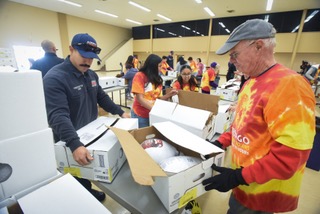
A: There are hundreds of hours of planning and behind the scenes work, from coordinating turkey deliveries to scheduling pickups for more than 100 groups. More than 100 volunteers help make it happen and their work is invaluable. That includes our Community Outreach Committee, our Tribal members, Tribal administrative staff, our Tribal police officers and firefighters, and our casino team members. We also provide breakfast and lunch for the volunteers.
- After 40 years, has the Thanksgiving Outreach become as much a Morongo tradition for the people giving as it is for the communities receiving? Are there Tribal members or casino team members who come back year after year — and can you share a story that captures what participating in this program means to them?
A: Absolutely, we see many of the same volunteers, committee members, and non-profit groups year after year, and it’s a labor of love for so many of us. There are a lot of hugs and handshakes as we all come together each year in the service of others. Personally, it’s one of my favorite events of the year because we get to experience firsthand the difference it makes in the community. Over the course of the program’s 40 years, Morongo has given away over 245,000 free turkeys, which have helped provide well over 4.5 million holiday meals to families, seniors, and veterans in need.
- Morongo has changed tremendously over these 40 years, but this program has remained. What does the Thanksgiving Outreach say about who Morongo is today — and what do you hope the next generation of Morongo members carries forward from this tradition?
A: This program says that Morongo hasn’t forgotten who we are, or where we came from. The Tribe has changed over 40 years, but our commitment to giving hasn’t. We gave when we had very little, and we give now because we’re able. Many families are feeling the strain of rising food costs and tight household budgets, and we feel blessed to be in a position to help. As for the next generation, I hope they see that giving back isn’t just something we do. It’s who we are and it defines us.